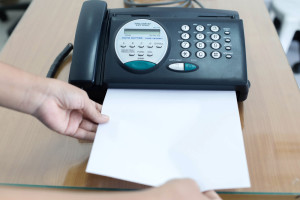
 Faxing is still an important part of a business. This is especially true for businesses that are looking to move away from traditional phone lines; faxes offer easy signature capture and regulatory considerations, and many partners may still request it.
There is some concern that fax over internet is unreliable for important business documents. However, businesses can know that their fax transmissions are going through if the T.38 protocol is properly implemented by carriers. This is also a more cost-efficient alternative to faxes sent over land line phones.
The Problem of Packets
Communications sent over IP rely on packets, meaning that fax information is sent in multiple pieces and put back together when it arrives. While this doesn’t affect a voice conversation enough to really be noticeable, faxes rely on a specific series of tones. If the packets are delayed, arrive out of order, or are dropped completely, then the tones are altered and cause the fax to fail.
T.38 Makes Faxing Reliable
T.38 was created in 1998 as a reliable way to send faxes over IP. It compensates for loss by re-sending UDP packets if the other side doesn’t receive them. This increases bandwidth use slightly, but T.38 doesn’t require much bandwidth in the first place and more than makes up for the higher bandwidth with its reliability.
Pros and Cons of T.38
T.38 is a guideline, which means that it can be interpreted and implemented in multiple ways. Because it is a complex protocol, it’s often added as an afterthought, which can result in a lost connection. Both endpoints and the carriers must be using the same interpretation in order to successfully send faxes over IP.
However, these problems with interpretation can be solved with a good translator. By using SIP signaling, any differences between interpretations can be easily and quickly fixed in real-time. With this, businesses can be confident that their important faxes will be sent reliably, without packet loss resulting in corruption or failure.
Although some may consider faxing an older and obsolete technology, the reality is that faxing will continue to be used, and with fax over IP it can replace the traditional land lines. Businesses considering the switch, or that are unsure about using fax over IP, should ensure that they use the T.38 protocol. With this protocol, and a translator that uses SIP signaling. Those businesses will be able to send even sensitive information quickly and reliably.
 Cloud computing has been around for a while, and in use by a variety of businesses. Why? There are many reasons to consider the cloud or hybrid cloud approach. Here are the top nine benefits to cloud computing, no matter what your business.
 The deployment of mobile technology is swiftly becoming a crucial aspect for business success. The global marketplace demands organizational flexibility through mobile solutions, and indeed, employees now have access to business systems on a wide variety of personal devices. And, because of that mobility, video conferencing has emerged as an important factor in sustaining unified communication and business collaboration.
 The advantages of cloud computing are becoming well-known as more and more companies choose cloud technology as a cost-effective business solution. It enables pervasive, convenient, on-demand access to a variety of computing resources including applications, networks, servers, and storage needs. All with very little effort and maintenance expense. Moreover, the flexible scalability of cloud-based services supports the feasibility of usage for large corporations, as well as SMBs.
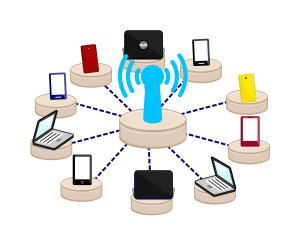 Cyber crimes have recently been carried out in shocking sophistication, sending waves of alarm bells to big enterprises. An enterprise’s communications system is the first vector of attack that criminals can target. Securing B2B unified communications (UC) with a cloud-based UC-as-a-Service (UCaaS) solution is a logical option.